
Today, 29-year-old Amara Kondeh stands comfortably in front of his home in Kono District, Sierra Leone, joyful, and a picture of strength that would have been hard to imagine five years ago. In 2020, after becoming severely ill in Guinea where he grew up and spent much of his young adulthood working as a truck driver. Amara arrived in Sierra Leone on the brink of death.
His illness had progressed quietly at first. Long days and cold nights driving large vehicles in Guinea seemed to have taken their toll and Amara fell severely ill. In his area, care was difficult to access, treatment was costly and Amara’s symptoms worsened. By the time he became critically sick, many of his relatives believed it was already too late and began preparing the traditional burial process. Only his older sister insisted he be taken to a health facility.
When the ambulance arrived to collect him, Amara was unconscious, paralyzed, and unable to stand. Even the ambulance driver said, “let’s leave this man, he’s almost dead,” doubting he would survive the trip to Kono. And yet, they continued.
When Community Health Worker (CHW) Tamba Nelson Jimisa first saw him, Amara was completely unresponsive, requiring urgent attention. Nelson remembers that moment vividly, “The ambulance brought him, his mouth was just empty like a dead man.”
From that point forward, Amara’s survival would depend not just on clinical treatment, but on the continuous support and accompaniment that lay ahead.
When CHWs Step In, Hope Follows
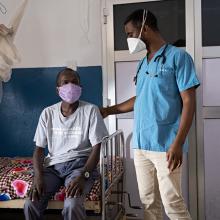
When the ambulance reached Partners In Health Sierra Leone (PIH-SL) supported Koidu Government Hospital (KGH), Nelson immediately stepped in to assist. Amara was still unconscious and unable to stand, so Nelson carried him to the X-ray department before he was admitted to the emergency unit. He was diagnosed with tuberculosis (TB) and remained under inpatient care, often unconscious and on oxygen, for almost four months before he was discharged to continue recovery at his new home in Kono, having relocated from Guinea for continued care.
Nelson was assigned as Amara’s CHW and became a constant presence throughout the hospital care and the transition home. In the facility, Nelson visited him daily, ensuring Amara received his medication and the supportive care he needed while unconscious.
After discharge, Nelson continued his daily visits, monitoring medication adherence and ensuring Amara could get fresh air and gradually regain mobility. Taking on practical hands-on tasks such as helping him eat, dressing and day-to-day accompaniment were what sustained Amara as he moved from unconsciousness to gradual recovery.
To an outsider, this may seem extraordinary. To a CHW, this is simply the job.
Nelson has cared for many patients whose illnesses were shaped by poverty, distance, and fear, and he often says that CHWs understand these struggles because they come from the same communities they serve. “Who feels it knows it,” he shares, a reminder that the work is driven not just by training, but by lived experience, empathy, and responsibility to their neighbors. For Nelson, that connection is what makes CHWs trusted, and what made Amara’s recovery possible.

Amara Kondeh (left) greets Nelson Jimisa, a community health worker, outside his house.
Ibrahim John Kamara / PIH
The Indispensable Role of CHWs in Kono District
Across Kono District, 119 CHWs engage with patients in the intimate, everyday ways that make treatment possible. Not only reminding them of appointments but showing up, physically, when families or patients need extra support. They operate across all 14 chiefdoms, reaching communities that are difficult to access due to distance, poor road conditions, or cost of transportation.
For Amara, those daily visits were crucial. It was not a single event, but hundreds of little moments of care, from picking up medications at the facility to gentle encouragement as he first tried to sit up or began speaking again.
While CHWs primarily work with patients facing conditions like HIV and TB, they also serve those experiencing malnutrition, chronic illnesses, as well as those in need of mental health support. CHWs are often the first trusted point of contact patients have with the health care system. From July 2024 to June 2025 CHWs supported a total of 5,344 patients and accompanied 39% more patients to clinical visits than the year before, underscoring the impact of their work.
Amara’s journey illustrates the central work of PIH-SL’s community-based programs (CBP). As Kumba Tekuyama, national CBP manager, explains, clinical care alone is not enough. “Care and support are needed beyond what we can provide in health facilities. Everything starts from the community and ends in the community,” she shares. With almost a decade overseeing community-based programming she understands exactly why CHWs are indispensable.
Kumba describes the CHW model not as an addition to the health system, but as its foundation. CHWs are recruited from their own villages, a deliberate choice that builds trust and acceptance. This community acceptance is essential, especially in places where health facilities are far, transport costs high, and past outbreaks have left people hesitant or afraid to go to facilities and seek care. “There’s a level of investment in the community, you feel passionate about it, you’re serving your people, you’re making a difference in the community,” Kumba says, emphasizing why local hiring matters.
Kumba also highlights that community-based work extends beyond health services to address the social determinants of health—linking people to nutrition, adult literacy, and livelihood skills-based programs to improve patients’ long-term resilience. This multi-level approach sustained Amara through his darkest moments and is a lifeline for many other patients like him.
Amara’s Remarkable Recovery
Amara’s recovery was not sudden, coming in slow, careful steps.
It was not merely the result of a single intervention, but the product of coordinated clinical care, persistent CHW accompaniment, and social support actions that together created a pathway back to health.
Amara remembers almost nothing from those first months, not the ambulance ride, not arriving at KGH, not the oxygen tubes that sustained him or the long days drifting in and out of consciousness.
But Nelson remembers everything. While Amara’s relatives in Guinea had lost hope, he was at Amara’s side as he began a long, slow fight back to life. Over several months and with Nelson’s daily home visits, checking on his medication, helping him move, and encouraging him to continue, Amara began to walk. Because these elements operated together, facility care, CHW support, and social support, Amara went from being unresponsive to regaining strength and being fully cured of TB. Months later, he could walk alone to Nelson’s house, something unimaginable to those who had once believed he was not worth transporting to the hospital.
Almost five years since Nelson was assigned as his CHW, the two have grown close, and Nelson has since been promoted to CHW supervisor.
For Nelson, the transformation was powerful as he was there at every stage. And for Amara, recovery and his experiences with CHWs transformed his view of health care. He no longer sees himself only as someone who received care, he sees himself as someone who can now help others.
“Because of what has happened to me, I myself can be a link now within the community,” exclaimed Amara.
He offers an encouraging message for anyone hesitant to seek help, based on his experience, “even if your relative is at the point of death, don’t lose hope take him to the hospital. He will get the care.”

Amara Kondeh moved from Guinea to Kono District, Sierra Leone, to access health care.
Ibrahim John Kamara / PIH
Future Rooted in Community
For Kumba, cases like Amara’s underscore why continued investment in community-based programs matter. The work is more than clinical outreach, it is an effort to build lasting relationships, local capacity, and community resilience. As a Kono native, “community means everything to me, we make the community all of us,” she says.
CHWs’ presence is what allows patients to access care, stay on treatment, and as in Amara’s case, rebuild a life. CHWs are trusted because they show up consistently, compassionately, and without hesitation for their community.
Nearly five years after the case that brought them together, Amara and Nelson’s friendship remains proof that, when facility care, community accompaniment, and social supports align, outcomes change.
It was the consistent presence of a CHW that helped Amara move from unconscious to recovery. Today, that presence continues to strengthen Sierra Leone’s health system, one community at a time.