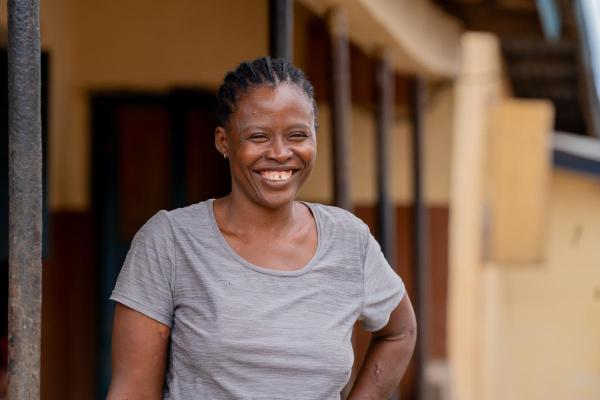
Aminata Mansaray Ngauja, originally from Kono District in Eastern Sierra Leone, was living in Guinea with her husband and their four children when her life changed suddenly. A teacher by profession, she had moved there with her family because of her husband’s work.
One day, he returned home earlier than usual complaining of severe back pain. He died soon afterwards.
Aminata went into profound shock. She remembers very little about the days that followed, including her husband’s funeral or how she eventually returned to Koidu, Kono District’s capital city. As her condition worsened, relatives brought her to PIH-supported Koidu Government Hospital (KGH), where she was admitted for mental health care.
She began receiving medication, counseling, and continued support from the mental health team. Over time, she became more stable and was eventually discharged. She continues to take medication as part of her treatment.
Today, Aminata describes her recovery as starting her life again.
That process has not been easy. She is now raising four children without her husband, and stigma around her mental health condition has made it difficult to return to teaching or find other work. Some people, she says, still struggle to accept that she has recovered and is capable of working again.
Aminata hopes to start a small business so she can support her children and become financially independent again.
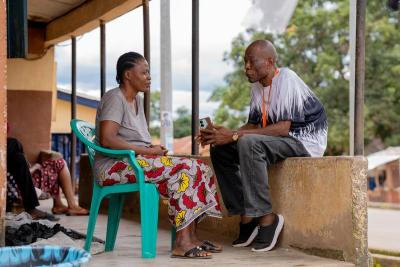
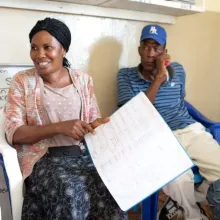
Aminata Mansaray Ngauja (left) receives a home visit from community health worker Lansana Kamara (right).
Photo by Sean Andrew Bangura / PIH
Mental health care at KGH is part of a wider effort by Partners In Health Sierra Leone (PIH-SL) and the Ministry of Health to make services more accessible in Kono District. Care includes clinical treatment, counseling, community follow-up, and support for patients as they return to their families and communities.
In fiscal year 2025, PIH-SL supported mental health services in Kono through KGH, Wellbody Clinic, Primary Health Care facilities (Sewafeh, Kombayendeh, Gandorhun, and Kayima), and community-based care, while continuing to strengthen referral pathways and psychosocial support for people living with mental health conditions.
Among those receiving care is 22-year-old Elizabeth Musa, who lives with bipolar disorder.
Before receiving treatment, Elizabeth experienced significant changes in her mood, periods of excessive talking, and episodes in which she would sometimes lose consciousness. Her family did not initially understand what was happening and sought help from traditional healers and churches before her grandfather suggested taking her to the mental health unit at KGH.
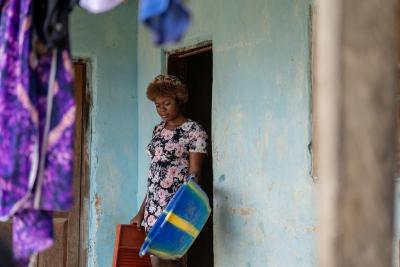
Elizabeth Musa, 22, who receives treatment for bipolar disorder at Koidu Government Hospital, does chores at home in Kono.
Photo by Sean Andrew Bangura / PIH
There, Elizabeth received a diagnosis and began treatment with medication and counselling.
She says her moods are now better regulated and that she feels more like herself again.
Her mother has remained supportive, although understanding Elizabeth’s condition took time. At one point, describing her as someone with “mental issues” contributed to stigma from relatives and classmates.
Elizabeth has continued with treatment and is now thinking about what comes next. She plans to begin university next year and hopes to study Public Health.
The experiences of patients such as Aminata and Elizabeth are also shaping how mental health care is delivered beyond the hospital. Community health workers support follow-up and help connect people to services, while psychosocial interventions and counselling provide additional support alongside medication.
PIH-SL has also supported mental health care nationally through the Sierra Leone Psychiatric Teaching Hospital in Freetown, including specialist training and efforts to build a stronger mental health workforce. In 2025, Sierra Leone reached an important milestone when Dr. Haja Abibatu Jalloh became the first psychiatrist trained in the country through its local psychiatry residency program.
In Kono, the next stage of recovery can look very different from one person to another.
Elizabeth is preparing for university.
Aminata is trying to return to work, care for her children, and rebuild the independence she had before her illness.
Both are continuing with treatment while moving forward with lives that extend well beyond their diagnoses.
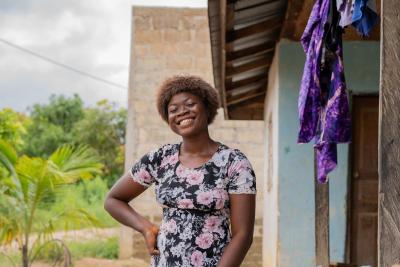
Elizabeth Musa, 22, is living with bipolar disorder and receiving ongoing treatment and counselling at Koidu Government Hospital in Kono.
Photo by Sean Andrew Bangura / PIH