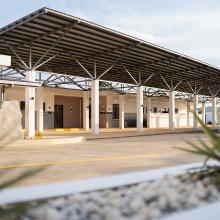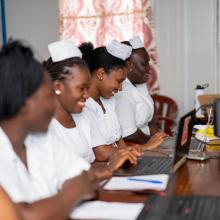
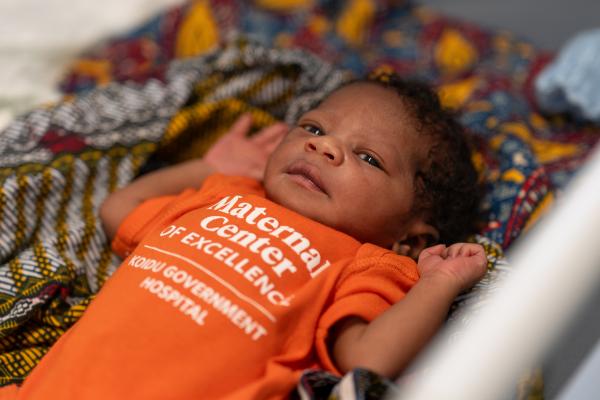
On February 14, 2026, a warm breeze swept over Koidu Town in Kono District, Sierra Leone, as the sun rose over the Paul E. Farmer Maternal Center of Excellence (MCOE). At 7 a.m., the new facility on the Koidu Government Hospital (KGH) campus was bustling with activity, as staff prepared for the first patient to arrive, putting the final touches in place. Clinicians finished stocking the crash carts, the janitorial team completed final cleaning, and the biomedical team ensured all equipment was turned on and functioning.
These were the last moments the MCOE would ever be without patients.
At 10 a.m., the MCOE opened its doors to the very first patients for inpatient maternal and neonatal care. The day marked a profound transition from years of planning, collaboration, and construction to the delivery of lifesaving care for women and newborns. In the first 24 hours of opening, the MCOE welcomed 27 patients, with a total of 13 babies born. Seven babies were delivered via cesarean section (C-section) and six via vaginal delivery.
First Patients at Registration and Triage
At 10:03 a.m., the first woman arrived at the MCOE’s registration desk after being directed there from KGH’s main entrance and screening point. Twenty-five-year-old Wulimatu Koroma came all the way from Waterloo, a five-hour drive from Kono, after hearing about the high-quality care provided at KGH. She was 36 weeks pregnant and experiencing chest pain. After being assessed at triage, Wulimatu became the first patient admitted to the antenatal ward to receive continuous care until delivery.
Fatmata Jalloh from Kono District was registered at the MCOE as the second patient. At 42 weeks into her pregnancy, she was past her due date. After the team assessed her at triage, they found that the protective fluid around the baby had become dangerously low, and an emergency C-section was needed. She delivered a healthy baby boy later that day— the second C-section performed at the MCOE.
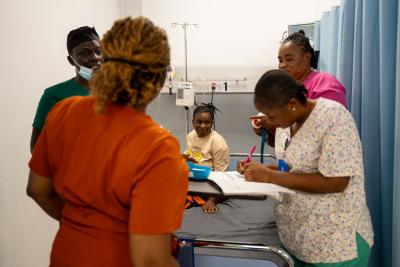
Fatmata Jalloh was the second patient to arrive at the MCOE on February 14. She was immediately assessed by a skilled team of nurses, midwives, and doctors at triage.
Caitlin Kleiboer / PIH
The First Outborn NICU and Mother’s Dormitory Admissions
At 10:13 a.m., the first neonate born outside the facility arrived at the MCOE and was admitted to the outborn section of the country’s first neonatal intensive care unit (NICU). The baby girl, Grace, was delivered 57 hours earlier at home. She did not receive enough oxygen at birth and, upon arriving at the NICU, immediately began receiving care, including being placed on oxygen support and laid in an infant warmer to regulate her temperature.
The baby’s mother, Phebian Baningo, was transferred to the postnatal ward for monitoring and later brought to the mother’s dormitory, a dedicated, dignified space where she could remain close to her baby in the same building.
Phebian had initially hoped to deliver her baby at the MCOE. “I heard the good news and was hoping one day I would see it for myself,” she said. But she traveled to a funeral toward the end of her pregnancy when she unexpectedly went into labor and was too far away from any clinical facility to make it to care in time. Phebian is now enjoying spending time with other mothers in the dormitory, and her baby girl is stable and getting stronger every day.
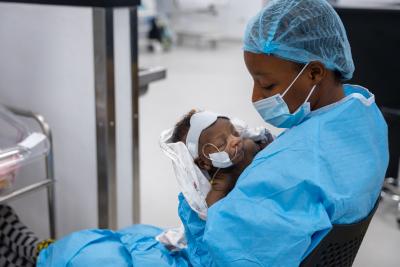
Phebian Baningo is comforting her baby girl in the outborn section of the country’s first neonatal intensive care unit.
Caitlin Kleiboer / PIH
First C-Section and Inborn NICU Admission
At 10:34 a.m., 17-year-old Fanta Jimmy from Kono District arrived at the MCOE’s triage and was assessed. The skilled team of nurses, midwives, and doctors determined that she was suffering from pre-eclampsia with severe features, and that her baby was in distress. An emergency C-section was needed as soon as possible.
Fanta was taken into the pre-anesthesia room to prepare for surgery. Due to the severity of her condition, her C-section was prioritized over other patients arriving at that time.
At 1:21 p.m., she gave birth to the first-ever baby born at the MCOE, a girl weighing 1.72 kilograms and measuring 41 centimeters in length. The premature newborn was immediately transferred to the inborn NICU in an incubator for specialized care
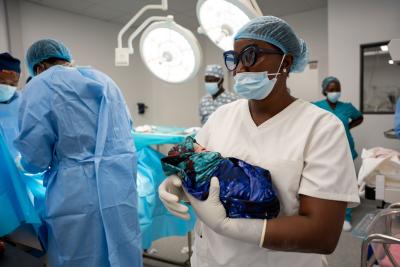
On February 14 at 1:21 p.m., the first baby was born at the MCOE via C-section.
Caitlin Kleiboer / PIH
The baby girl is now stable, doing well, and eating eagerly.
After recovering in the post-operative ward, Fanta moved to the mother’s dormitory, where she will stay until her daughter is ready to go home. Fanta’s mother, Yei, has been a devoted birth companion and is ready to support her granddaughter wherever needed. They enjoy spending time together in the MCOE courtyards.
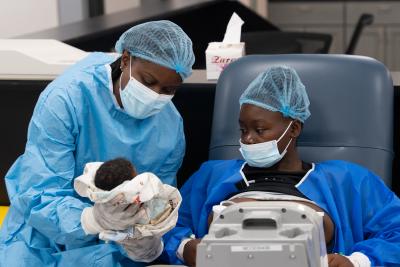
Fanta Jimmy from Kono District gave birth to the first-ever baby born at the MCOE via C-section. The premature newborn was immediately transferred to the inborn NICU for care. Executive Director, Vicky Reed (left), is holding Fanta’s baby girl next to Fanta in the NICU.
Chiara Herold / PIH
First Referral via Ambulance
At 2:27 p.m., the first ambulance arrived at the MCOE carrying 33-year-old Sia Jimissa from Kono District. Throughout her pregnancy, Sia attended antenatal appointments at her local clinic.
On the morning of February 14, she began experiencing contractions and went to the clinic to give birth. However, after three hours of labor, the clinical staff identified complications and called an ambulance to refer her to KGH.
Sia’s sister accompanied her in the ambulance for support. Upon arrival at the MCOE, the team determined that Sia had prolonged labor and that her baby was in distress, requiring an emergency C-section. She safely delivered a healthy baby boy not long after.
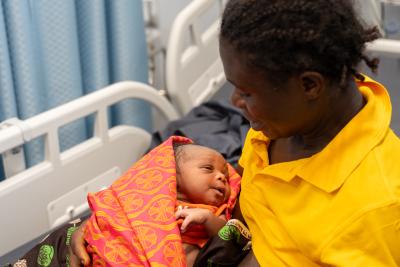
The first ambulance arrived at the MCOE carrying Sia Jimissa from Kono District. She safely delivered a baby boy via emergency C-section.
Chiara Herold / PIH
First Vaginal Delivery
At 8:17 p.m., Fatmata Sow arrived at the labor and delivery ward and became the first woman to give birth there, delivering her baby girl at 12:25 a.m. on February 15. It was a smooth delivery with no complications.
Fatmata had been attending antenatal appointments at KGH throughout her pregnancy, where she first learned about the MCOE. She was excited to welcome her fifth child at the new facility.
Fatmata’s husband, Amadu, accompanied her to KGH and stayed by her side throughout the delivery as her birth companion. After delivery, both Fatmata and her baby recovered in the postnatal ward before returning home to their family.
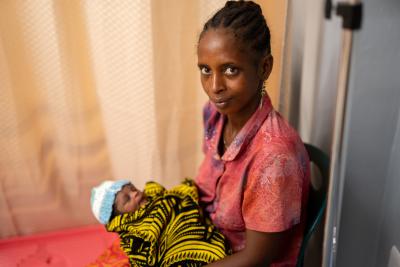
Fatmata Sow became the first woman to give birth at the labor and delivery ward inside the MCOE. She delivered a healthy baby girl at 12:25 a.m. on February 15.
Nishant Chandrasekar / PIH
The Start of a New Era
The first 24 hours at the MCOE were filled with moments of excitement, anticipation, and rapid decision-making by a team of outstanding clinicians. Years of planning, construction, and training finally came together to provide every woman and newborn who arrived at the MCOE with the highest standard of care, in a dignified, patient-centered, and beautiful environment.
We are deeply grateful to the Government of Sierra Leone through the Ministry of Health, especially Dr. Austin Demby, Minister of Health, for believing in the vision of the MCOE and walking alongside PIH-SL to make it a reality.
We thank Build Health International, led by Co-Founder and Managing Director Jim Ansara, for transforming architectural sketches into healing spaces, one wall at a time.
None of this would have been possible without the endless support of the district health management team, local chiefs, and community leaders and members standing as vital allies, advocating for improved maternal care.
And we are profoundly thankful to John and Hank Green, and to every supporter who believed in this dream and donated, making it possible for mothers to leave the MCOE with healthy babies and smiles on their faces.