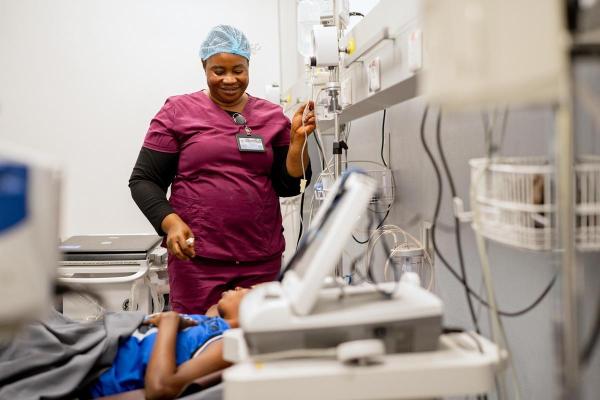
At Koidu Government Hospital (KGH), before the Paul E. Farmer Maternal Center of Excellence (MCOE) opened in February 2026, pressure in maternity and newborn care showed up in visible ways: too few beds, too few hands, too many patients arriving at once.
Clinical care continued at the Partners In Health (PIH)-supported hospital because it had to. But it did not move with the kind of order that allows a team to work consistently and confidently.
Moinya Lukulay, Benjamin Moripeh, Jeneba Mannah, and Frank Mohamed Rogers were already working inside that pressure. They were nurses serving across KGH’s old maternity ward, special care baby unit (SCBU), and maternity theater.
“It was like a disorganized setting. The place was overcrowded with patients,” Lukulay said.
Mannah remembered it in much the same way: “We were working as if just to save lives. We were not working in a systematic order.”
Around them, the strain took different forms. Moripeh, who worked in the SCBU, described caring for premature babies with too few incubators and monitors available. Rogers, who spent years moving between main theater and maternity theater, described a workload stretched across both spaces because there were simply too few staff.
The learning gap
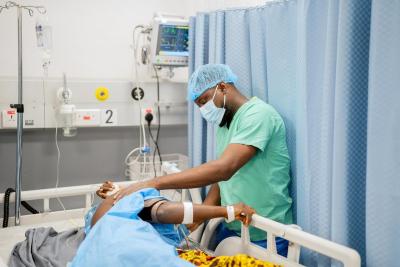
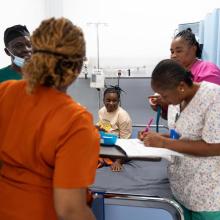
Nurse Frank Mohamed Rogers follows up on patients in the Maternal Center of Excellence’s Postoperative ward.
Photo by Sean Andrew Bangura / PIH
Lukulay, Moripeh, Mannah, and Rogers had been working within clear limits. As State Enrolled Community Health Nurses (SECHNs) at the hospital, there were responsibilities they could not formally take on, roles they could not fully grow into, and opportunities that stayed closed to them – similar to the distinction between a licensed practical nurse and registered nurse in the United States.
Mannah recalled that, as a SECHN, she could not go to the theater to receive a baby because of her cadre. Becoming a State Registered Nurse (SRN) represented freedom as much as advancement. “When you become an SRN, you will be capable of working anywhere,” she said.
“I lost many opportunities because I wasn’t an SRN,” Rogers said, recalling chances to pursue further training that passed him by because he lacked the necessary qualification.
Lukulay felt similarly, wanting to deepen her clinical knowledge and provide better care. Moripeh, too, had long seen the SRN qualification as a way to move toward the level of skill and responsibility he aspired to.
For Sister Isata Dumbuya, director of nursing and midwifery at the MCOE, that need was clear.
These nurses had practical experience, Dumbuya said, but there were important learning gaps. They lacked some of the theoretical grounding needed to fully explain, plan, and individualize patient care.
Through support from the Takeda Pharmaceuticals’ Global Corporate Social Responsibility Programme, PIH provided scholarships for nurses at KGH to pursue further training to close those gaps. Lukulay, Moripeh, Mannah, and Rogers understood the opportunity immediately. They also understood the cost.
Leaving home to learn
In October 2022, having been awarded the Takeda-supported scholarship, all four left to upgrade from SECHNs to SRNs through the nursing diploma programme at the St. John of God Catholic School of Nursing in Lunsar, Sierra Leone. The programme is approved by the Nurses and Midwives Board of Sierra Leone and affiliated with the University of Makeni.
Each semester combines classroom learning with clinical placement, giving students time to study and apply what they learn in hospital and community settings. To graduate and qualify for professional registration, students must complete 96 academic credits, finish a research-based client care study, complete all required clinical hours, and pass the national pre-professional licensing exams.
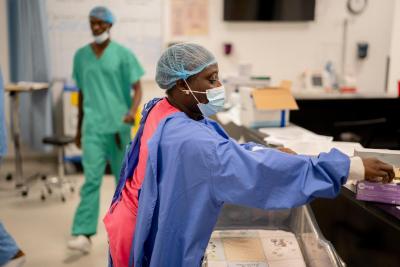
Nurse Jeneba Mannah works at the Maternal Center of Excellence’s triage and helps out at the PACU when they are short on on-duty staff.
Photo by Sean Andrew Bangura / PIH
For Lukulay, leaving meant stepping away from her children, but she saw the opportunity as something she could not afford to miss, and she decided for them to stay with relatives while she went back to school.
Mannah worried about how her family would manage while she was away and living on a stipend. Rogers stepped away as the main provider in his household. Moripeh left behind a daughter who was still very young, while also trying to hold together a difficult situation at home.
Dumbuya said the opportunity mattered for another reason. These were nurses who needed the chance to prove something to themselves: that they were capable, worthy of investment, and that someone was willing to take that chance on them.
The three years that followed during the State Registered Nursing Programme were demanding, but also full of discovery.
“I almost decided to leave,” Lukulay said. It had been a long time since she was in school, and she felt that gap sharply. “I was the oldest person in the class, and everyone else seemed to grasp complex concepts much faster. I persevered because I didn’t want to let down the people who supported me.”
The others describe the same period in slightly different terms. Mannah remembered the pressure of the first exams, knowing that failure would come at a cost. Rogers had to adjust to an academic environment after years in clinical practice. Moripeh found his footing quickly, took on leadership among his peers, and finished among the strongest students in his cohort.
Returning to KGH and the MCOE
What stayed with them after completing the training was how they thought about care. Lukulay, Moripeh, Mannah, and Rogers returned to KGH in August 2025 with a different relationship to clinical judgment, nursing process, decision-making, and to what it means to act before being told what to do.
For Lukulay, that difference became clearest in how she now approaches a patient. Earlier in her experience, she would sometimes notice a patient’s abnormal vital signs, record them, and wait for further direction from her superiors. “Before the arrival of a doctor, I have done my own part,” she said. Now, following her training, she assesses, responds, and prepares the next steps in care.
The same is true for the other nurses too.
“Nursing is not just about giving medication. You need to find problems and solutions,” said Moripeh.
They did not come back to the same place they had left; the hospital had also shifted. The MCOE was soon to open on KGH’s campus, bringing a more structured environment for maternal and newborn care. Departments were more clearly organized, staffing had improved, electronic medical records had been introduced, and workflows that once felt improvised were becoming more defined.
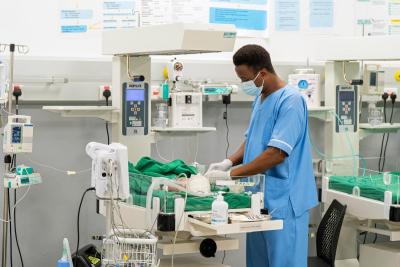
Nurse Benjamin Moripeh works in the Neonatal Intensive Care Unit (NICU) of the Maternal Center of Excellence.
Photo by Sean Andrew Bangura / PIH
Now working in Sierra Leone’s first neonatal intensive care unit (NICU), Moripeh sees a difference in how infection prevention and control is practiced, especially compared with what he knew in the SCBU. The new facility’s systems and structures are also improving patient care significantly.
Likewise, Lukulay spoke about how electronic medical records now allow nurses to follow a patient’s case before transferring across wards. Rogers pointed to the effects of clearer roles and division of responsibilities, particularly in theater, where he now sees a difference in coordination and focus.
From Dumbuya’s perspective, the change in the nurses themselves has been just as visible.
“Since returning,” she said, “they have become more confident, more knowledgeable, and more skilled, and are now able to provide more competent care to their patients.”
That shift carries into the way they work with others. Dumbuya described each scholarship recipient as strong advocates for patients, supportive team members, and nurses whose standards of care others now try to emulate.
“I always put myself in the condition of the patient,” Rogers said.
Dumbuya noted that, just as importantly, they are willing to share what they know.
Across the team, that knowledge is being applied in practice. Lukulay moves more confidently through emergency cases and supports junior colleagues. Mannah is already looking toward further training in midwifery. Moripeh leans into mentorship and evidence-based care. And Rogers brings a steady focus to teamwork, dedication, and empathy.
Looking ahead, Dumbuya sees these nurses taking on even more responsibility as the MCOE grows. She expects them to mentor student nurses and, in time, to grow into team lead roles themselves.
The work at KGH has not always been easy. But in ward upon ward, improvements are appearing: in what a nurse notices, in what a team can coordinate, and in how quickly care begins to move for every patient.
As Moripeh put it: “When you acquire knowledge, it improves you. What you know is what you can deliver.”